Different years I have played around with and experimented with reading logs. I even had a year when I tossed them out and went by books read or pages read after reading resources from Nancie Atwell and Donalyn Miller, as well as reflecting on my own reading life. Nonetheless, I have realized that in my teaching context, reading logs are part of the school wide culture from kindergarten to fifth grade and it made sense to continue that on through 8th grade.
In addition, juggling reading in two languages and knowing that kids sometimes read multiple books at a time, I noticed that reading logs are a valuable tool in tracking students' reading lives. This summer I was reading resources by Lucy Calkins and colleagues (Pathways to the Common Core and the reading PDFs). I appreciated the way that they highlighted reading logs as a tool for student self reflection in addition to a teacher tool. As I reconsidered reading logs in preparation for the new school year, those ideas influenced my thinking.
This year, based on having students doing their independent reading in three different classrooms, I decided to have students record both their in school and at home reading onto the same log (rather than the log being for at home reading and doing a status of the class for in school reading). Even if they were all still in my class, I appreciate the way that having their two reading times side by side allows for a better snapshot into their reading lives. It also allows students to be more accountable for their reading lives and the decisions they are making as readers.
Students are expected to read the 35 minutes of independent reading at school Monday to Thursday and 30 minutes at home Monday-Friday. I include Saturday and Sunday on the reading log as optional days. Before I tried to be as efficient as possible with paper, such as getting a quarter long reading log set up; however, this year I decided to go week by week in order to preserve that record by reducing the chance of students losing a reading log that had weeks worth of data on it.
Instead, each Thursday they file their complete reading log into a folder that stays in the classroom and receive a new one. There is a self-assessment on the back of the reading log where they assess themselves in two categories: time reading and engagement while reading.
If students meet the minimum reading requirements and are engaged while reading, they earn a 90% A. If they go above and beyond by either reading over 30 minutes during the week or by reading on the weekend, they earn a 100% A. If they miss reading sessions the grade decreases (i.e. 1 session B, 2 sessions C, 3-5 sessions D, more than 5 F). Their grade for the week is calculated first by time spent reading, but then they have to have the reading engagement behaviors to maintain that grade. For example, if the reader met the minimum time requirements but frequently switched books/grabbing random books off the shelf, they would not earn an A.
The rubric has opened up conversations about what they can be doing in order to support their growth as a reader, as well as behaviors and habits that can stifle that growth. At the end of each quarter students will revisit all of their logs so far and write a reflection on their reading lives, including goals for the next quarter.

Showing posts with label Reading. Show all posts
Showing posts with label Reading. Show all posts
Wednesday, October 3, 2012

Monday, December 19, 2011
Deeper Reading

Last year, a colleague and I talked frequently about moving students toward a deeper level of understanding. As such, I closely connected with concepts I read about in Comprehension Going Forward this summer. As the title implies, Gallagher's book is another great contribution to an on-going conversation about moving beyond surface-level comprehension.
At the start of the book, he discusses baseball as a metaphor for the way that adolescents read. Drawing from experiences with his daughters, comparing their understanding of the game to his own, as well as watching them develop their knowledge-base over time, Gallagher made connections to adolescents as readers. Referring to his daughters and baseball, he stated, "They now read the game at a fairly sophisticated level, but they were taught how to do so. They did not acquire their skill spontaneously or randomly," (p. 3). The book continued on to explore implications for teachers to scaffold the way students read.
Published in 2004, this is one of Gallagher's earlier books; however, it is still highly relevant. While reading, I frequently thought about current discussion about the CCSS emphasizing a need for deep understanding. Gallagher's book is a blend of anecdotes, rationales for needs, and strategies to address needs. He explains each of the strategies and provides specific examples of many. It is evident that his suggestions are based on close-observation of students and intentional teaching over time. I have frequent notes in the margin of how I will implement his suggestions.
It felt great to finally read a professional development book for pleasure again. This break I am looking forward to reading more of the books that I have been wanting to read for a long time.
Tuesday, June 21, 2011
The Fountas and Pinnell Prompting Guide

The guide is constructed on thick paper with a cover that can be used to set the guide up on a table for teachers to easily flip through it utilizing the convenient tabs during instruction. The tabs provide various summarized focal teaching points for both reading and writing, including left/right, voice-print, word beginnings, rate pausing, placing words, and monitoring/correcting. In addition, each tab lists the broader goals such as early reading behaviors, general problem-solving, and constructing words.
The pages have an easy to follow lay-out that is simple in order to avoid making the page too busy. Each section provides a brief introduction and instructions for teachers about what to observe in students. They also have headings with the full versions of the focal teaching points, as opposed to the condensed versions on the tabs. The pages are divided into three columns under each heading that mirror the cover words and color scheme: teach (in purple), prompt (in red), and reinforce (in green).
It is clear that Fountas and Pinnell decided to keep a clean, crisp layout to match their purpose of classroom utility vs. other professional development resources meant to provide detailed explanations. While the resource on its own is powerful, it would be even more advantageous for those using it to have a rich foundation in literacy learning as well. Luckily, the authors provide a list of professional references in the introduction which will be valuable for teachers who do not yet feel confident with their level of understanding behind the teaching points in this prompting guide.
The product is marketed as a scaffold for k-6 teachers. While some of the tabs are definitely relevant only to emergent literacy, such as reading left to right or the verbal path for letter formation, I agree that many of the other tabs are appropriate and helpful for the upper grades. As a mom, I appreciate the resources for younger grades because it is farther from my comfort zone when it comes to literacy. For example, the verbal path for letter formation is helpful because I have never had to explain how to form letters as my students already know how, so it is a tool that will help me as a parent.
Fountas and Pinnell also have the prompting guide available with Spanish components for bilingual literacy teachers. Tomorrow I will post more about that version.
Copy provided by the publisher
Sunday, February 13, 2011
Fresh Takes on Teaching Literary Elements

I read most of Reading Don't Fix No Chevys this summer and I have heard a lot about one of the authors because he is a professor at the university where I am getting my Ed.D., so I was familiar with the authors and interested to see their latest book. When I saw them talking about transferring learning on the Amazon preview, I could not resist purchasing it right away. I could tell that their philosophy aligned with the well-known workshop, "Read like writers and write like readers."
For my cognition class this semester, I had been thinking of doing my research project on whether or not writing to learn journals seem to have an impact on helping students facilitate what they notice as readers into their own writing vs. solely discussing what they notice. When I got the book, I realized that there were many mentions of cognition and it actually pointed me toward investigating situated cognition further. I always love it when a book aligns even more closely with a current focal area than I had anticipated.
Aside from the cognition and transfer aspects, in general I just loved the book. Toward the end of last year I was realizing that students were getting comprehension strategies that I had focused on a lot over the last couple of years but that they were not prompting students to deeply analyze texts, so I began considering how to scaffold students' abilities to move toward analysis. This book has many ideas on how to work toward that goal.
Most of all, one of my favorite aspects was the frequent mentions of the value of studying literature as a means to help students develop a stronger understanding of themselves and their worlds which leads to a positive impact on their overall long-term success. A key component of achieving this is through inquiry units. I started out the year intending to have inquiry focal questions all year long but it has not happened. The book was a good reminder to layer that essential component in for the remainder of the second half of the year.
The book provided me with plenty to consider with cognition, analysis, and inquiry, so I look forward to trying out some of their ideas and then revisiting the book again later in order to remind myself of other aspects that I will not be able to immediately implement.
Thursday, January 20, 2011
Drawing From Personal Experience to Think Aloud Approaching Texts
This semester I am taking my first statistics course. Though I have been nervous for the class for quite some time because it is so far out of my comfort zone, I felt fortunate to have a professor who lowered my affective filter on our first class this Tuesday. It also helped that my classmates also seemed to feel insecurities when it comes to statistics when compared to other classes in our program.
Gearing up to read and reading through my first readings for the class, I was thinking about how it is always beneficial to stretch ourselves as readers in order to put ourselves in the shoes of our students to then share how we approach texts with them. While before I had texts that were challenging, I think this is one of the first texts in a long time where I truly knew that no matter how many times I read it, I would not start to really understand it until I go to class next week. These will definitely be texts where I need scaffolding from my professor. Luckily, he mentioned to the class that we would feel this way at the start of the semester. We'll see if by the end of the semester I am able to be more independent following the gradual release of responsibility model or if the content is still too new to feel that sense of ease with the texts.
Last year I wrote about a writing to a prompt as a genre unit that I am doing again right now with my students. This year I am also going to do a short test reading genre study as well. It is still coming together in my mind exactly how I will map it out, but I know that I will focus on the importance of reader's/writer's purpose, making the connections between what we are highlighting for our writing to a prompt genre study and our test reading genre study. I will also be talking about how reader's adjust depending on the type of reading they will be doing.
While reading my statistics this week, I realized or had some thoughts reaffirmed that I can share with my students about difficult texts:
Gearing up to read and reading through my first readings for the class, I was thinking about how it is always beneficial to stretch ourselves as readers in order to put ourselves in the shoes of our students to then share how we approach texts with them. While before I had texts that were challenging, I think this is one of the first texts in a long time where I truly knew that no matter how many times I read it, I would not start to really understand it until I go to class next week. These will definitely be texts where I need scaffolding from my professor. Luckily, he mentioned to the class that we would feel this way at the start of the semester. We'll see if by the end of the semester I am able to be more independent following the gradual release of responsibility model or if the content is still too new to feel that sense of ease with the texts.
Last year I wrote about a writing to a prompt as a genre unit that I am doing again right now with my students. This year I am also going to do a short test reading genre study as well. It is still coming together in my mind exactly how I will map it out, but I know that I will focus on the importance of reader's/writer's purpose, making the connections between what we are highlighting for our writing to a prompt genre study and our test reading genre study. I will also be talking about how reader's adjust depending on the type of reading they will be doing.
While reading my statistics this week, I realized or had some thoughts reaffirmed that I can share with my students about difficult texts:
- It is important to think about level of familiarity with the content of a text before beginning in order to think about how to approach it. With my statistics readings, I know that I have very little background knowledge. That means that I will always need to read it (or at least ideally): when I am well rested, when there are no or very few distractions, and when I do not feel under pressure (such as a time crunch). I also need to go into it realizing that I will need to slow down, but at times, speed up when I realize that I am at sections that are still beyond my comprehension.
- Realistically with this text I was able to get some of the big ideas. Classmates who took the introductory statistics course said that even with high levels of confusion with the readings, it was still helpful to "prime the pump" for class instruction. Knowing that was the expectation, I was able to relax and clearly identify where I had some understanding and where I felt completely lost and knew that I would need to listen very closely to class discussions in order to fill in those gaps.
- It was also essential to try to sift through the information to try to categorize the priority level of the information. I watched for key words that pointed toward what would be major take-away points. For example, it talked about the purpose of certain distributions. I know that one of the program goals for students is to at minimum be able to understand the statistics that we read in research, even if we are not going to conduct quantitative research. Thus, knowing the purpose of each distribution will be key in being a strong consumer of research, so when I saw those key words, I knew to slow down and grasp on to anything I could.
I am glad that through statistics I will not only learn a whole new content area, but it will also provide me an opportunity to reflect on what I do as a reader, how I can piece together information as I navigate unfamiliar texts, and have to work hard to build background knowledge and then apply it to future readings. It is also valuable to share with students my own vulnerabilities as a reader and that it is more important to recognize confusion and seek strategies to patch up gaps in comprehension (either independently or with the assistance of someone else, depending on the situation), rather than being too proud to express confusion.
Sunday, October 3, 2010
Google Sites Books Read List
Earlier this fall I wrote about my journey to find a platform for my students to share the books that they have been reading and how I ended up going with Google Sites that is available through Google Apps Education Edition. I also did a follow-up post to explain how I envisioned students writing about their books. Yesterday when I wrote a first quarter update post, Tara requested more information about how I set up student Google Sites, so I thought it was a perfect time to share how the process has been going.
Since Google Sites was new to me, I have been experimenting right along with the students, making sure to try out everything that I request they do before hand in order to share an example and walk them through the process. As always with technology, it is so nice to have a classroom set of laptops and a SMART Board where I can walk students through the process of exactly what they should be doing.
Students created their sites, which was super easy since they already had their education edition email accounts, so it was as easy as clicking a few buttons. I had each class categorize their site by the year they will graduate from our school as eighth graders, making it easy for me to skim through sites by class and for them to look for their classmates' sites as well. On the welcome page they wrote a statement about themselves as readers and writers. This gives me as a teacher a lot of insights into them.
Next, each student created a new page, set up as an announcements page (functioning like a blog) titled 2010-2011 Book List. Every time they finish a book, they are supposed to write a post reacting to the book. I have a rubric posted on my site, as well as maintaining my own book list for them to use as examples. This has not been too much work for me because I can often copy and paste responses directly from my book blog, often with just a few adjustments to tailor it to my students as an audience instead of my wider open blog audience.
Each post is supposed to be titled with a number and title. The number reflects the amount of books they have read this year. For example, a title might be: 3. Diary of a Wimpy Kid: Rodrick Rules, which would mean that it was the third book the student completed since the school year started. Each month I have two deadlines. One is for students to choose one English book response, and the other is for a Spanish book response. I have them write the one that they want me to look at on the bottom of their weekly self-evaluation form. Then I skim through their selected posts.
We just completed our first round, and I was able to make note of areas in which I can scaffold them to improve. Topics range from remembering conventions to adding depth to their reader reaction to hooking their readers with their summaries without giving away too much of the book. Right now I kept the posts simple without adding book cover images or links in order to focus on the content. Later on I will layer in these aspects.
A few students have already begun to visit each other's sites and leave comments for each other, but I have not demonstrated this yet. That will be one of the next steps so that they can start enjoying the benefits of having a community of readers sharing about books they love virtually to complement the ways that they share about their books in person.
I will try to remember to add additional posts throughout the year as I continue reflecting and improving, but please feel free to leave a comment with any suggestions or questions you might have that I can post about in the future.
Since Google Sites was new to me, I have been experimenting right along with the students, making sure to try out everything that I request they do before hand in order to share an example and walk them through the process. As always with technology, it is so nice to have a classroom set of laptops and a SMART Board where I can walk students through the process of exactly what they should be doing.
Students created their sites, which was super easy since they already had their education edition email accounts, so it was as easy as clicking a few buttons. I had each class categorize their site by the year they will graduate from our school as eighth graders, making it easy for me to skim through sites by class and for them to look for their classmates' sites as well. On the welcome page they wrote a statement about themselves as readers and writers. This gives me as a teacher a lot of insights into them.
Next, each student created a new page, set up as an announcements page (functioning like a blog) titled 2010-2011 Book List. Every time they finish a book, they are supposed to write a post reacting to the book. I have a rubric posted on my site, as well as maintaining my own book list for them to use as examples. This has not been too much work for me because I can often copy and paste responses directly from my book blog, often with just a few adjustments to tailor it to my students as an audience instead of my wider open blog audience.
Each post is supposed to be titled with a number and title. The number reflects the amount of books they have read this year. For example, a title might be: 3. Diary of a Wimpy Kid: Rodrick Rules, which would mean that it was the third book the student completed since the school year started. Each month I have two deadlines. One is for students to choose one English book response, and the other is for a Spanish book response. I have them write the one that they want me to look at on the bottom of their weekly self-evaluation form. Then I skim through their selected posts.
We just completed our first round, and I was able to make note of areas in which I can scaffold them to improve. Topics range from remembering conventions to adding depth to their reader reaction to hooking their readers with their summaries without giving away too much of the book. Right now I kept the posts simple without adding book cover images or links in order to focus on the content. Later on I will layer in these aspects.
A few students have already begun to visit each other's sites and leave comments for each other, but I have not demonstrated this yet. That will be one of the next steps so that they can start enjoying the benefits of having a community of readers sharing about books they love virtually to complement the ways that they share about their books in person.
I will try to remember to add additional posts throughout the year as I continue reflecting and improving, but please feel free to leave a comment with any suggestions or questions you might have that I can post about in the future.
Saturday, October 2, 2010
First Quarter Update
Once again, the school year is flying by. This week we had parent-teacher conferences, and it was a great feeling to have all of my scheduled families show up, which is typical for my school. We are now officially in October, and by the end of the month, the first quarter will be over. This year my main adjustment has been a nice shift to only teaching reading and writing, but having less class time for the content areas. I have been carefully balancing how to best utilize the time available, and I can tell that I will continue to adjust and readjust, still trying to weave some components in.
I also had a realization in the first few weeks that over the last three school years my content responsibilities have narrowed, as well as the amount of time that I spend with each class. As a result, I inadvertently focused more and more on my content, rather than taking the time to firmly establish a sense of classroom community, so I did some back pedaling after the first couple of weeks to try to compensate for trying to dive into academics too fast, at the expense of getting to know you activities. This was especially essential for my 6th grade class, since my 7th and 8th graders were returning students, so we already had a greater sense of community.
One of the most exciting changes this year is that I have been collaborating with our TOSA for reading support to have her push-in to my classroom instead of pulling out students. So far we have both been very excited about the possibilities and it seems to be going very smoothly. We are both learning together and meeting frequently to discuss how we can best support all of the readers in our classroom in flexible groups. Our first round of book clubs are up and running, something that I always love.
I finally let go of having a reading log, and instead chose to focus on a books completed log with a reading reflection post on a Google Sites page for each student. I am still reflecting on this change, but my initial thoughts are that it has been positive. One initial challenge was that it was a few weeks into the school year before we had our technology parent meeting to get technology agreement forms signed and returned from parents and students. In that span of time some 6th graders had read multiple books and then felt overwhelmed about the prospect of updating their site with every reading reflection. Instead, I made updating the site optional. Instead, they were required to at least list the titles of the books but gave the option to maintain a paper/pencil copy of the response, rather than adding them all on-line. I am assessing one English and one Spanish book response each month. We already have a note to ourselves to have parents fill out technology agreements in our 5th grade spring parent meeting so that we can start the year ready to utilize technology.
I also had a realization in the first few weeks that over the last three school years my content responsibilities have narrowed, as well as the amount of time that I spend with each class. As a result, I inadvertently focused more and more on my content, rather than taking the time to firmly establish a sense of classroom community, so I did some back pedaling after the first couple of weeks to try to compensate for trying to dive into academics too fast, at the expense of getting to know you activities. This was especially essential for my 6th grade class, since my 7th and 8th graders were returning students, so we already had a greater sense of community.
One of the most exciting changes this year is that I have been collaborating with our TOSA for reading support to have her push-in to my classroom instead of pulling out students. So far we have both been very excited about the possibilities and it seems to be going very smoothly. We are both learning together and meeting frequently to discuss how we can best support all of the readers in our classroom in flexible groups. Our first round of book clubs are up and running, something that I always love.
I finally let go of having a reading log, and instead chose to focus on a books completed log with a reading reflection post on a Google Sites page for each student. I am still reflecting on this change, but my initial thoughts are that it has been positive. One initial challenge was that it was a few weeks into the school year before we had our technology parent meeting to get technology agreement forms signed and returned from parents and students. In that span of time some 6th graders had read multiple books and then felt overwhelmed about the prospect of updating their site with every reading reflection. Instead, I made updating the site optional. Instead, they were required to at least list the titles of the books but gave the option to maintain a paper/pencil copy of the response, rather than adding them all on-line. I am assessing one English and one Spanish book response each month. We already have a note to ourselves to have parents fill out technology agreements in our 5th grade spring parent meeting so that we can start the year ready to utilize technology.
Friday, June 11, 2010
Reading Ladders
"Readers are made, not born. The experiences we present students can have terrific influence, sometimes more than we can see at the time" (p. 17).

There was so much to love about this book. I could tell from the beginning that I would like the tone because as I have mentioned numerous times about other authors, I appreciate it when they write as a colleague who can share their experiences, give thoughts to ponder, and make their ideas more transparent. She encouraged her readers to use her ideas as a starting point but to remember that we are the experts making decisions based on our students and contexts. In addition, Lesesne focuses on conditions that foster life-long reading.
The concept of reading ladders is to not just match students with one great book that they will love, but to have successive books to recommend. She talks about reading horizontally (for example series), vertically (a big jump in reading demands), and diagonally (a progressive moment with support - a reading ladder). Lesesne said, "Simply, a reading ladder is a series or set of books that are related in some way (e.g., thematically) and that demonstrate a slow, gradual development from simple to more complex. [...] The intent is to move readers from their comfort zone to books that represent more diversity" (p. 48). She then went on to give many diverse, thorough examples of the possibilities of reading ladders.
I kept a pen close by as a read to jot down all the ideas that popped into mind as I read through her examples, such as:
- She mentioned how some reading ladders span years. I have 6th-8th grade students, so I thought about having some reading ladder visuals posted around the room and/or on our class blog with different colors (or some other distinction) to show the recommended entry grade level. I was also reflecting on how I could have a visual representation of the horizontal reading that goes on until the reader is ready to move on to the next rung of the latter.
- I want to think of the progress and growth of my incoming 8th graders from the time they started in my class as 6th graders. Remembering their reading journeys could help me create some of our class' reading ladders.
- I am going to have a theme of the year for each of the grade levels, and I thought it would be great to have a reader ladder for each theme.
- Classics and remakes ladder
- Student created ladders (After writing this idea, I realized that Lesesne later recommend it on page 65 with ideas on how to scaffold their own creations.)
- Book Clubs reading ladders (with books in our library available in multiple copies)
- And of course, I will need to make sure to have some Escaleras de lectura, to represent Spanish titles in our classroom library.
I am excited for all of the possibilities that there are with reading ladders and to see the impact they will have on my classroom.
Saturday, May 29, 2010
"Guy Books"
For the YA Lit class that I am taking, I decided to focus on "guy books" after that was the way one of my students referred to most of the books that he read this year from our classroom library. Last year when I would book talk a lot of the books that I bought to read and then passed on to the library, many of the boys would grumble that they were mainly girl books. This year I made more of a conscious effort to buy more books for the boys; I still have a lot of catching up to do though. So, while I have plenty of books that are more appealing to girls in my to read pile, I thought the class would be a great chance to buy more books for boys. There are not any required texts other than YA books, so it was a nice excuse to justify placing a couple of Amazon orders, thinking about how much I typically spend on textbooks for other college courses!

This week I read Tyrell and Mexican Whiteboy to see if they would be a good fit for my incoming 8th grade boys. However, because of the mature themes mentioned in Tyrell, my initial gut instinct is that it would be better for high school students. Mexican Whiteboy also has a lot of mature content, but I am leaning toward including it. You can see more thoughts about Tyrell here and about Mexican Whiteboy here. I am thinking that a lot of the books I chose will be tough calls on whether or not they are a good fit for a middle school vs. high school classroom library because a lot of the boys are drawn to books with real life problem/issues themes.
The two required books for the course were The Absolutely True Diary of a Part-Time Indian and American Born Chinese. Then we each needed to choose seven more books, with a few stipulations. They are all supposed to be award winners or on recommended lists. At least one had to be a "problem" novel and one had to be historical fiction.
Here are my seven books, aside from the two already mentioned:
Sleeping Freshmen Never Lie by David Lubar
Deadline by Chris Crutcher
Copper Sun by Sharon Draper
Inexcusable by Chris Lynch
Carter Finally Gets It by Brent Crawford
These are the other books that I bought on the same order with the boys in mind:
Crash Boom Love by Juan Felipe Herrera (The girls have been crazy about novels in verse this year, I want to get more novels in verse that will also appeal to boys)
Romiette and Julio by Sharon Draper
The First Part Last by Angela Johnson
Growing Up in Slavery: Stories of Young Slaves as Told By Themselves by Yuval Taylor (We are supposed to read a non-fiction piece on the same topic as our historical fiction pick.)
Fire from the Rock by Sharon Draper
Street Love by Walter Dean Myers
I also pulled a few other books from my TBR pile to make sure and read this summer.
Tuesday, May 25, 2010
Scheduling Ponderings
Last Friday was our last day of school, so I am officially in the reflecting/refining/planning for 2010-2011 school year mode. Next year will be the first year that our school will have grown through 8th grade. The exciting piece that comes along with that is that I will be teaching all three grades 6th-8th in language arts only. While I will miss social studies, I am glad that I will not have to try to fit reading, writing, and social studies into a shorter block of time.
One of the major areas that I am pondering right now is with the schedule. I am anticipating that I will have about 1 hour 12 minute blocks daily with each class. My priorities are to have time for read aloud with a reading focus lesson, writing focus lessons (writer's notebooks, Everyday Editing, traits, etc.), independent reading time, independent writing time, and word study. Then there are also other components that are not daily, such as Author Tip Tuesday, that I am trying to figure out exactly where they will fit.
Here are some initial thoughts running through my mind for options. I would love any feedback/thoughts on the different options. I am going to try to work through in my mind about what my preference is by the time I go to Heinemann's Boothbay Literacy retreat (only 33 days away, but who's counting?) because I know the retreat will be a great time to reflect on my ideas/thoughts.
Option #1: Have both independent reading and writing every day but only enough time for either a writing or reading focus lesson
One of the major areas that I am pondering right now is with the schedule. I am anticipating that I will have about 1 hour 12 minute blocks daily with each class. My priorities are to have time for read aloud with a reading focus lesson, writing focus lessons (writer's notebooks, Everyday Editing, traits, etc.), independent reading time, independent writing time, and word study. Then there are also other components that are not daily, such as Author Tip Tuesday, that I am trying to figure out exactly where they will fit.
Here are some initial thoughts running through my mind for options. I would love any feedback/thoughts on the different options. I am going to try to work through in my mind about what my preference is by the time I go to Heinemann's Boothbay Literacy retreat (only 33 days away, but who's counting?) because I know the retreat will be a great time to reflect on my ideas/thoughts.
Option #1: Have both independent reading and writing every day but only enough time for either a writing or reading focus lesson
- 20 min. Independent Reading
- 20 min. Read Aloud with focus lesson or Writing focus lesson
- 20 min. Independent Writing
- 10 min. Word Study
- 15 min. Read Aloud with focus lesson
- 10 min. Word Study
- 15 min. Writing Focus Lessons
- 30 min. Independent Reading or Independent Writing
- 10 min. Word Study
- 15 min. Read Aloud/Focus-Lesson
- 15 min. Independent Reading
- 15 min. Writing Focus Lesson
- 15 min. Independent Writing Time
Sunday, April 25, 2010
Igniting a Passion for Reading

In his book, Layne dedicates a chapter for each of the following areas: targeting aliterate readers (those who can read but do not have a desire to do so), knowing your students, book chats, read alouds, modeling, book discussions, reading lounges, celebrating books, author visits, and a sample quarterly plan. I loved that at the end of each chapter, with the exception of the last, he had a reflection called from the trenches followed by contributions from authors discussing memorable teachers in their literacy lives.
Reading his ideas to foster a love of reading leading into life-long readers was a great way to reflect on current practices and a new lens to consider ideas that have been simmering for quite a while with regards to planning for next year. Many of the ideas were not new concepts, but it was the idea of seeing it again at a different phase in my career, making me realize that it is a good book for pre-service teachers, teachers in their first years, as well as teachers with years of experience. Whether it is seeing the ideas for the first time or to remind ourselves of important concepts in our personal teaching philosophies, reflecting on or reworking strategies we use in the classroom, this book opens up a good dialogue.
Sunday, April 11, 2010
State Testing Reflections - Data Teams
Last year my school started the official process of data teams, putting the spotlight on the importance of holding ourselves accountable to collecting a wide variety of student data and using it to inform our instruction. Another important piece to this process is collaborating as colleagues. Sometimes this means we meet with our grade level teams, as language teams (Spanish teachers and English teachers), content area teams, or as a whole staff. Our director frequently dedicates time at our regular staff meetings to share celebrations or new ideas as a group. While my 7th graders obviously are not working toward the same standards as the kindergarten class, as teachers we are still able to learn from each other and the processes we are using to become better practitioners.
My growth as a teacher has come from a combination of experience, support and training at my school, as well as self-directed professional development through wide reading and blogging. While I will continue revamping and fine tuning, here is a glimpse into how data teams comes into play with my current unit on inferencing in reading.
We had a brief focus on inferencing earlier in the year, but it was apparent that students could still benefit from a longer, more in depth unit on inferencing. As a result, we will be spending our remaining Spanish weeks focusing on the area. I just gave my students a pre-test on inferencing. I took an excerpt from Julia Alvarez's En busca de milagros with open-ended questions eliciting different types of inferencing that we will be emphasizing. The initial data collected from the pre-test will give me a better ideas of where my students are right now, combined with observations throughout the year from a variety of sources.
Next week we will continue on with focus lessons, drawing on ideas from When Kids Can't Read: What Teachers Can Do, Mosaic of Thought, I Read It, But I Don't Get It, and Middle School Readers. I will collect data through informal observations during focus lessons, anecdotal records during conferencing, quick checks with an iTouch during independent reading, student application of inferencing in their reader's notebooks and reading response letters, application with unfamiliar texts and state stem questions, as well as the post test.
With data teams I have been able to use data teams in combination with state blueprints and specifications to help students make the link between our independent reading with more authentic responses and state testing reading selections. Students see how they can use the same strategies with their own reading and recognize the type of wording used on state assessments. This way the bulk of my instructional time is focused on authentic self-selected reading and conferencing with adults and peers, yet there is still a piece in place for students to be aware of how the state assessment (and other assessments) work.
My growth as a teacher has come from a combination of experience, support and training at my school, as well as self-directed professional development through wide reading and blogging. While I will continue revamping and fine tuning, here is a glimpse into how data teams comes into play with my current unit on inferencing in reading.
We had a brief focus on inferencing earlier in the year, but it was apparent that students could still benefit from a longer, more in depth unit on inferencing. As a result, we will be spending our remaining Spanish weeks focusing on the area. I just gave my students a pre-test on inferencing. I took an excerpt from Julia Alvarez's En busca de milagros with open-ended questions eliciting different types of inferencing that we will be emphasizing. The initial data collected from the pre-test will give me a better ideas of where my students are right now, combined with observations throughout the year from a variety of sources.
Next week we will continue on with focus lessons, drawing on ideas from When Kids Can't Read: What Teachers Can Do, Mosaic of Thought, I Read It, But I Don't Get It, and Middle School Readers. I will collect data through informal observations during focus lessons, anecdotal records during conferencing, quick checks with an iTouch during independent reading, student application of inferencing in their reader's notebooks and reading response letters, application with unfamiliar texts and state stem questions, as well as the post test.
With data teams I have been able to use data teams in combination with state blueprints and specifications to help students make the link between our independent reading with more authentic responses and state testing reading selections. Students see how they can use the same strategies with their own reading and recognize the type of wording used on state assessments. This way the bulk of my instructional time is focused on authentic self-selected reading and conferencing with adults and peers, yet there is still a piece in place for students to be aware of how the state assessment (and other assessments) work.
Saturday, April 3, 2010
Can't Hardly Wait!
Kylene Beers, Robert Probst, Nancie Atwell, Sara Kajder, Linda Rief, and Chris Crutcher all at one literacy and technology retreat!? Oh, and did I mention it is offered through one of my all time favorite publishers, Heinemann? I could hardly contain my excitement just thinking about the possibility of going to the Boothbay Literacy Retreat, but today as I clicked through my web registration it is hard to believe that I will actually get to go.
All the pieces are coming together. As if the conference wasn't enough to be excited about, I will fly into Boston to spend a couple of days with my sister who has been living in Massachusetts for the last three years while her husband did his medical residency there. Then she will take me to the retreat in Maine and pick me up. Next, it will be time for her and her family to drive cross country to move back to the Pacific Northwest. On the way we will be able to see another one of our sisters in Iowa, as well as our 1 year old niece that we have only been able to see one other time! I have never had a chance to drive cross country either.
There is so much to look forward to. The only downside is that I, of course, will miss my girls and husband. I think I will be gone about two weeks total. My mom just reminded me that a couple of summers ago I helped out with an institute for two weeks in the summer, and I survived being away from my family. I will, however, make sure to spend a lot of time with the girls before going on my trip.
It is still hard to believe that I actually get to go. I will make sure to have writer's notebooks with me to document my experiences. I am certain the experience will inspire many WN entries that I can later share with my students. I will definitely be posting a lot about this experience.
*Note: Even though I do not have reviews/comments on my blog about each of the literacy leaders who will be at the retreat, I have books from each one (Sara Kajder's new book is the latest addition to my professional development library, and I will be posting about it soon). I have loved every single one. It is great to recognize all the names and have a reason to be excited for each one.
All the pieces are coming together. As if the conference wasn't enough to be excited about, I will fly into Boston to spend a couple of days with my sister who has been living in Massachusetts for the last three years while her husband did his medical residency there. Then she will take me to the retreat in Maine and pick me up. Next, it will be time for her and her family to drive cross country to move back to the Pacific Northwest. On the way we will be able to see another one of our sisters in Iowa, as well as our 1 year old niece that we have only been able to see one other time! I have never had a chance to drive cross country either.
There is so much to look forward to. The only downside is that I, of course, will miss my girls and husband. I think I will be gone about two weeks total. My mom just reminded me that a couple of summers ago I helped out with an institute for two weeks in the summer, and I survived being away from my family. I will, however, make sure to spend a lot of time with the girls before going on my trip.
It is still hard to believe that I actually get to go. I will make sure to have writer's notebooks with me to document my experiences. I am certain the experience will inspire many WN entries that I can later share with my students. I will definitely be posting a lot about this experience.
*Note: Even though I do not have reviews/comments on my blog about each of the literacy leaders who will be at the retreat, I have books from each one (Sara Kajder's new book is the latest addition to my professional development library, and I will be posting about it soon). I have loved every single one. It is great to recognize all the names and have a reason to be excited for each one.
Saturday, February 27, 2010
Reflections
I can hardly believe that in just a few weeks I will already be at the end of the third quarter. This whole year I have been reflecting constantly about what is working and what I need to improve with language arts and social studies. Next year as our school grows I will only be teaching reading and writing because our third teacher that we will hire soon will be for social studies and science.
With that change my reflections have shifted a bit. I am still considering how I can improve in order to maximize student growth in social studies this year. For example, lately I have been scaffolding their abilities to write to learn. When I reflect I usually think about what is feasible for immediate implementation and what is a long term goal. Social studies still fills a lot of my short term thoughts, but my long term thoughts are language arts based with the exception of thinking how I will be able to at times do integrated units with the science/social studies teacher.
My main consideration for next year is deciding what my components will be knowing that the time configuration is going to be different. I am considering that I many need to alternate days having one day focus on reading, while the other focuses on writing even though I would want to have some aspects of both every day. That will give me plenty to mull over for quite a while, but I have a lot of ideas that I am excited about. I will be posting more details about certain aspects as I am able to integrate them (some later this spring and others next year).
A lot of my summer reflections/planning will be refining ideas that I tried this year. For example, I know that I want to improve with word study, my implementation of Anderson's ideas, my genre units, and my mini-lessons.
With that change my reflections have shifted a bit. I am still considering how I can improve in order to maximize student growth in social studies this year. For example, lately I have been scaffolding their abilities to write to learn. When I reflect I usually think about what is feasible for immediate implementation and what is a long term goal. Social studies still fills a lot of my short term thoughts, but my long term thoughts are language arts based with the exception of thinking how I will be able to at times do integrated units with the science/social studies teacher.
My main consideration for next year is deciding what my components will be knowing that the time configuration is going to be different. I am considering that I many need to alternate days having one day focus on reading, while the other focuses on writing even though I would want to have some aspects of both every day. That will give me plenty to mull over for quite a while, but I have a lot of ideas that I am excited about. I will be posting more details about certain aspects as I am able to integrate them (some later this spring and others next year).
A lot of my summer reflections/planning will be refining ideas that I tried this year. For example, I know that I want to improve with word study, my implementation of Anderson's ideas, my genre units, and my mini-lessons.
Sunday, December 13, 2009
Book Response Letters
I just completed my fourth week of book response letters, and I wanted to post about how it has been going. I previously mentioned that I did not start the letters sooner because I originally found the idea of responding to my 50 students on a weekly basis daunting, but I found a system that made the process feasible. While it is still time consuming and a bit stressful at times to keep up with, I also find that it is one of my most enjoyable non-student contact activities. I love having this added level of insight into my students as readers.
Here are some quick thoughts on my ponderings as I am still new to letters:
*It is helpful to have a web page open to Amazon while reading/responding. I can quickly look up a book a student is talking about or answer questions they have, such as whether there is a sequel. I also double check information about books that I want to mention to them.
*Some students automatically wrote with the level of insights that I want to guide all students toward, while others still mainly write a summary. I have had discussions with the class about what the letters should be like. I can see that they will be on-going discussions to continue to nudge students in the right direction. After mentioning to students that I wanted them to be writing about what they think about as readers, including strategies they use, some students started to write about strategies in a generic way. For example, they listed out different strategies without connecting them to a book they are reading. As I have more experience with book response letters I will know how to introduce the concept better.
*I am planning on having some students start their own blogs fairly soon after the winter break, and I will have them write book reviews, rather than a book response letter. While these will not be exactly the same, it will still require students to process information about their books. They will still have a response from me, as well as the added possibility of peer feedback.
Here are some quick thoughts on my ponderings as I am still new to letters:
*It is helpful to have a web page open to Amazon while reading/responding. I can quickly look up a book a student is talking about or answer questions they have, such as whether there is a sequel. I also double check information about books that I want to mention to them.
*Some students automatically wrote with the level of insights that I want to guide all students toward, while others still mainly write a summary. I have had discussions with the class about what the letters should be like. I can see that they will be on-going discussions to continue to nudge students in the right direction. After mentioning to students that I wanted them to be writing about what they think about as readers, including strategies they use, some students started to write about strategies in a generic way. For example, they listed out different strategies without connecting them to a book they are reading. As I have more experience with book response letters I will know how to introduce the concept better.
*I am planning on having some students start their own blogs fairly soon after the winter break, and I will have them write book reviews, rather than a book response letter. While these will not be exactly the same, it will still require students to process information about their books. They will still have a response from me, as well as the added possibility of peer feedback.
Saturday, November 28, 2009
Conferring Walk-Aways Wrap-Up
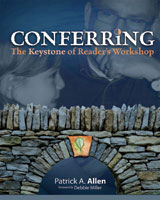
My posts about Conferring walk-aways were only a glimpse into the information that I took from Allen's book. When I was originally listing out possible topics to include, I quickly realized that I could continue posting for a long time on this one book. I imagine that I will often revisit the book as I gain more experience with conferring to once again reevaluate my progress and areas where I would still like to improve.
Here is a list of some of the areas that I did not write posts about to give you an idea of other topics the book addresses that I found helpful:
*The rationale for sitting side by side when conferring. I had heard this often before but had been pondering what was the most feasible with the layout of my classroom. I had considered going to students without actually sitting down versus having students come to me and being able to sit side by side. After reading Allen's book I realized how essential it is to go to students and sit side by side. I was able to figure out a way to make this happen with my present lay out.
*Knowing students as readers through conferences.
*All readers need conferences; there is not a stage where they are so proficient that they no longer need to confer.
*Small groups versus conferring
*Networking with colleagues and personal professional development
*Jumping in too fast
*The ins and outs of finding a record system that works for each individual teacher
*Being able to explain the benefits of conferring to others
Friday, November 27, 2009
Conferring Walk-Aways Parent/Staff Involvement
 Last year our school started to have grade-level meetings throughout the year to talk to parents about specific academic areas. I am still planning out our meetings with my teaching partner for this year. Last year my parent meetings ended up being about new technology in the classroom and my students' first ever over-night field trip to visit a college. This year I want to make sure that in addition to these types of meetings I also include topics specifically related to language arts.
One of my favorite sections in Conferring was "Lingering Questions and Answers About Conferring with Readers". It concisely reviewed concepts that he had mentioned at various points in the book, as well as some new thoughts. I was particularly interested in his answer to how teachers can utilize parents and staff members. He gave many specific tips on where parents should start when conferring and what types of information they can note about their children, as well as questions they can ask. He concluded by saying, "It is important that we teach parent volunteers and support staff how to confer with readers. Knowing how to confer makes their work with students more purposeful and meaningful" (184).
I realized that Allen was probably talking about parents as volunteers, but he got me to think about how this could be a powerful parent meeting topic. Our parents who are able to often ask about how they can help their students at home. Many of the parents read and discuss books with their children. Allen's suggestions give me so many ideas on how I could provide support for parents to confer with their children if they are not already doing so. It is also a great way for them to understand our workshop model in class.
His comments also gave me new ideas on how to support my instructional assistant in conferring with readers. Earlier this year I had asked a question at Two Writing Teachers if they had suggestions for best utilizing instructional assistants in the workshop. One of them had mentioned the benefits of having them confer (I tried to find the post so I could link it but didn't). I loved the idea, but I quickly realized that since I was so new to conferring and did not have my own system down yet, it was hard to explain what I wanted my assistant to do. Now that I am getting more comfortable I am getting to a point where I can add in this piece utilizing Allen's ideas for starting points.
Monday, November 23, 2009
Conferring Walk-Aways The Student's Role
 It makes me laugh when I think back to my recent first attempts at conferring and starting up with comments such as "How's it going?" It was easy for me to see the validity to this type of approach in order to allow students to do most of the talking during the conference. However, I had not thought of one key component - not all students will naturally begin a detailed conversation providing insights into themselves as a reader when they are not sure what their role is in conferring. With Allen's book I had an aha that I needed to be more intentional in talking to students about why we were conferring, what their role is, and how I would like to see them progress as they get more comfortable with conferring.
 I made a note to myself to check in with my students. It was not a very long check-in, but I noticed a huge change automatically. From time to time I will talk to my students as a group to redefine and guide students to taking their conferring comments to the next level as I notice the need. For now, just having a simple conversation has helped prepared students to be ready to do the talking, rather than giving me confused looks or expressions that let me know they are wondering what the purpose is when I sit down to confer with them. While some students were able to naturally open up about themselves as readers without having discussions about conferring as a whole class, I am so glad that Allen's book made me realize that it is necessary for overall success for the whole class.
Sunday, November 22, 2009
Conferring Walk-Aways Useful Data
 Data has become a huge area of focus in my school, as it has in so many schools in this age of high-stakes testing. I loved the way that Allen mentioned ways to specifically use information gathered from conferences to use as valuable data. He emphasizes that by keeping anecdotal records of each conference, teachers are able to analyze notes to see emerging trends and notice what we learn about our students as readers over time (15). Without records that anecdotal notes provide, it would be easy to not have a specific trend or aha moment about a student click with a teacher. It is powerful to reflect on notes and skim over the last conference before beginning a new one. It helps teachers be more intentional and also confirms other forms of more standardized data or helps us to dig deeper if results do not match up with what we have observed on a day to day basis.
 There was a very powerful excerpt where Allen reflects on data and programs from his point of view as a parent. "When I sit down with my child's teacher, I do not want to see a number on a piece of paper about her being in the ninety-eighth percentile for this or that, unless the teacher can explain how that affects my daughter's interactions with text. I do not want to see a graph showing me that my child reads a passage quickly and moves along a continuum, unless the teacher can explain how she varies her rate and prosody when she is reading aloud and how the miscues she is making may be interfering with her comprehension. [...] I want my child's teacher to tell me what strategy she is working on in reading or what writer's craft she is studying. I want to know what she is thinking about when she's doing it, and how she is sharing that learning with her teacher and the rest of her classmates" (139). These are two of my most favorite paragraphs out of the whole book. I highly recommend that anyone pondering data specifically linked to workshops should get a copy of the book to read the full two paragraphs. Afterward, Allen shifts back to himself as a teacher and how we must also use standardized measures to demonstrate growth.
Toward the end of the book Allen reiterates different ways that anecdotal notes from conferences can be powerful for teachers (184-185). Through his comments I have been able to better define the importance of conferring and how it will help me with a wide variety of purposes: getting to know my students as readers, recognizing trends over time, helping me to better communicate with parents, provide the necessary piece to triangulate data and know readers from different angles.
Even though I feel like I am just barely getting the hang of conferring and it is starting to feel more natural, I can already see how rich the data that I am recording about my students is. I am excited for the way that conferring is going to impact how I know my students as readers and the information it is providing to be a more mindful teacher.
Friday, November 20, 2009
Celebrations
I have so many posts rolling around in my head and just need to find the time to type them up! Until then, here is a quick glimpse into reasons for excitement this week...
1) I started weekly book response letters. It was a great feeling to respond to my students and to have that individualized interaction with them. It is going to be a great record of their growth as readers. At first I found the idea of responding to all 50 of my students on a weekly basis daunting. However, I figured out a system that works for me.
*I looked at my 6th and 7th grade class lists side by side and figured out how I could break up the alphabet in order to have a manageable amount of students hand in their reader's notebooks. Looking at the lists helped me to tailer it specifically to my students this year, rather than choosing arbitrary points in the alphabet.
*Rather than writing my responses to my students, I decided to type them notes. This is not only more time efficient but it also helps students to understand my comments better. They have often said that they can not read my handwriting since they are not as familiar with cursive writing. I have tried printing before, but it is hard to print for an extended length. Typing the responses will work out great. I staple them to their letter page.
*If students are participating in a book club for the week, they will not write me a book response letter. The letters are the same format as their book club book responses, so I will give them credit for their weekly response letters based on their book club response. This is both fair for students and again helps it to be manageable time-wise for me.
2) I am quickly gaining confidence with conferring. I will be posting a lot more about this with my Conferring Walk-Aways posts. The mixture of conferring and book response letters is going to provide me with such valuable information about my students as readers, in order to better communicate to parents and help move them along to the next level to extend their reading abilities.
3) I started my first ever on-line book club this week. Everything went fairly smoothly, and I am excited about the possibilities with this new piece. I will be relflecting on this in more detail later as well.
1) I started weekly book response letters. It was a great feeling to respond to my students and to have that individualized interaction with them. It is going to be a great record of their growth as readers. At first I found the idea of responding to all 50 of my students on a weekly basis daunting. However, I figured out a system that works for me.
*I looked at my 6th and 7th grade class lists side by side and figured out how I could break up the alphabet in order to have a manageable amount of students hand in their reader's notebooks. Looking at the lists helped me to tailer it specifically to my students this year, rather than choosing arbitrary points in the alphabet.
*Rather than writing my responses to my students, I decided to type them notes. This is not only more time efficient but it also helps students to understand my comments better. They have often said that they can not read my handwriting since they are not as familiar with cursive writing. I have tried printing before, but it is hard to print for an extended length. Typing the responses will work out great. I staple them to their letter page.
*If students are participating in a book club for the week, they will not write me a book response letter. The letters are the same format as their book club book responses, so I will give them credit for their weekly response letters based on their book club response. This is both fair for students and again helps it to be manageable time-wise for me.
2) I am quickly gaining confidence with conferring. I will be posting a lot more about this with my Conferring Walk-Aways posts. The mixture of conferring and book response letters is going to provide me with such valuable information about my students as readers, in order to better communicate to parents and help move them along to the next level to extend their reading abilities.
3) I started my first ever on-line book club this week. Everything went fairly smoothly, and I am excited about the possibilities with this new piece. I will be relflecting on this in more detail later as well.
Subscribe to:
Posts (Atom)