Once again an idea hit me on how to be even more efficient with the data that I collect while conferring with readers. Earlier this week I mentioned I was at a technology conference and exploring on the new iTouch that my director bought for teachers at our school in order to familiarize ourselves with them before we roll them out for 1-to-1 student use. The possibilities will be endless, including a powerful way to combine Google Docs forms with the iTouch.
At a Google Docs presentation the presenter showed us how to quickly and easily create forms and how they show up in a Google Docs spreadsheet. Right away my teaching partner and I created a form to track discipline. Now we will have one, central location for to track student behavior and infractions. In addition, other staff members will also be able to input tracking information. We always share with our students that they should, "Do what is right even when nobody is watching." Utilizing Google Docs forms will make it even easier for them to feel a sense of accountability of meeting up to our high behavior expectations.
Next, I realized that Google Docs forms would also be an excellent tool for conferring. I created a form for reading conferences. I am still deciding how much I will use it, but I will use it for sure for quick check ins. For example, a recent focus lesson revolved around questioning. Given a similar situation, I would create a quick form to mark off students' present level of ability to apply the strategy to their reading. It will automatically be in a spreadsheet and I will be able to provide sufficient support in a more timely manner, as opposed to needing to collect, sort, and make decisions the old way.
The iTouch will be so convenient when I am doing quick conferences and only documenting specific information in a form that does not require me to type out a longer reflection. When I want to be able to type out a longer response I will still utilize a laptop.
So many possibilities. So much to get excited about...

Showing posts with label conferring. Show all posts
Showing posts with label conferring. Show all posts
Saturday, February 20, 2010

Tuesday, January 5, 2010
Personal Narrative Revision Conferences
This week I have been conferencing with my students about their personal narratives as they are revising. I still feel like such a conferring novice, but here are some of the points that I am learning as I go along.
*While I am still developing my conferring skills in general, it was perfect to have the notes that I took from when I was reading drafts over the break right in my conferring document. I wrote areas of improvement/suggestions/comments I would want to make in the next step column. It was great to have that as a guide for my conferences. As I conferred I gauged how much my students seemed ready to absorb and at times I adjusted my original plan to mention less of my comments and to add others to long term goals of areas to improve. It was nice to go into the conference with a plan. However, I realize that sometimes it is challenging to have a good turn around of reading all of my students' drafts outside of class. Next time I am going to try reading partial drafts in class and giving suggestions along the way in a more consistent, systematic way, rather than collecting all as a complete draft. Not only do I think this will save time outside of class, but I think I will be more efficient. Now that I have my system for electronic anecdotal notes set up, I think this will work much better. Then I will still read their final published drafts and take notes as I did with this set of drafts to continue to guide future instruction and areas to build on.
*While conferencing, it is so fulfilling to hear students say, "I remembered you said before..." Watching student growth unfold before my eyes is such an amazing experience.
*One advantage to reading the drafts outside of class was that I was able to create a list of general trends that I was noticing in student writing. Before conferencing individually, I posted and discussed a list of ideas to consider while revising with my students. Then by the time that I got to many students they had already revised their drafts with the ideas in mind. It was an excellent way to see what my students were able to do on their own. It did not take me long to realize that I should start each of my conferences with, "What have you revised so far?" Often students stated that they made a revision based on a teaching point. When they showed examples, they demonstrated that they had made meaningful steps along the way and opened up a perfect opportunity to give authentic scaffolding specific to their writing piece or to further develop a good start they had on the concepts. If they had not tried out the suggested ideas yet, then I talked to them about example revisions using their draft. Next time when I try reading drafts/partial drafts in class I will still keep a running list of common trends and address them at the start of writing workshops as needed, and I will always start .
*While I am still developing my conferring skills in general, it was perfect to have the notes that I took from when I was reading drafts over the break right in my conferring document. I wrote areas of improvement/suggestions/comments I would want to make in the next step column. It was great to have that as a guide for my conferences. As I conferred I gauged how much my students seemed ready to absorb and at times I adjusted my original plan to mention less of my comments and to add others to long term goals of areas to improve. It was nice to go into the conference with a plan. However, I realize that sometimes it is challenging to have a good turn around of reading all of my students' drafts outside of class. Next time I am going to try reading partial drafts in class and giving suggestions along the way in a more consistent, systematic way, rather than collecting all as a complete draft. Not only do I think this will save time outside of class, but I think I will be more efficient. Now that I have my system for electronic anecdotal notes set up, I think this will work much better. Then I will still read their final published drafts and take notes as I did with this set of drafts to continue to guide future instruction and areas to build on.
*While conferencing, it is so fulfilling to hear students say, "I remembered you said before..." Watching student growth unfold before my eyes is such an amazing experience.
*One advantage to reading the drafts outside of class was that I was able to create a list of general trends that I was noticing in student writing. Before conferencing individually, I posted and discussed a list of ideas to consider while revising with my students. Then by the time that I got to many students they had already revised their drafts with the ideas in mind. It was an excellent way to see what my students were able to do on their own. It did not take me long to realize that I should start each of my conferences with, "What have you revised so far?" Often students stated that they made a revision based on a teaching point. When they showed examples, they demonstrated that they had made meaningful steps along the way and opened up a perfect opportunity to give authentic scaffolding specific to their writing piece or to further develop a good start they had on the concepts. If they had not tried out the suggested ideas yet, then I talked to them about example revisions using their draft. Next time when I try reading drafts/partial drafts in class I will still keep a running list of common trends and address them at the start of writing workshops as needed, and I will always start .
Tuesday, December 8, 2009
Reading and Writing Conference Conversation
I was excited to see that Stenhouse authors Mark Overmeyer and Patrick Allen just started a Voice thread conversation about reading and writing conferences. Conferring continues to be a hot topic for me right now as I am trying to gain more confidence and become more effective. I encourage you to join the conversation and am excited to follow this conversation as it develops!
Saturday, November 28, 2009
Conferring Walk-Aways Wrap-Up
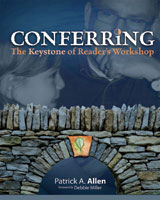
My posts about Conferring walk-aways were only a glimpse into the information that I took from Allen's book. When I was originally listing out possible topics to include, I quickly realized that I could continue posting for a long time on this one book. I imagine that I will often revisit the book as I gain more experience with conferring to once again reevaluate my progress and areas where I would still like to improve.
Here is a list of some of the areas that I did not write posts about to give you an idea of other topics the book addresses that I found helpful:
*The rationale for sitting side by side when conferring. I had heard this often before but had been pondering what was the most feasible with the layout of my classroom. I had considered going to students without actually sitting down versus having students come to me and being able to sit side by side. After reading Allen's book I realized how essential it is to go to students and sit side by side. I was able to figure out a way to make this happen with my present lay out.
*Knowing students as readers through conferences.
*All readers need conferences; there is not a stage where they are so proficient that they no longer need to confer.
*Small groups versus conferring
*Networking with colleagues and personal professional development
*Jumping in too fast
*The ins and outs of finding a record system that works for each individual teacher
*Being able to explain the benefits of conferring to others
Friday, November 27, 2009
Conferring Walk-Aways Parent/Staff Involvement
 Last year our school started to have grade-level meetings throughout the year to talk to parents about specific academic areas. I am still planning out our meetings with my teaching partner for this year. Last year my parent meetings ended up being about new technology in the classroom and my students' first ever over-night field trip to visit a college. This year I want to make sure that in addition to these types of meetings I also include topics specifically related to language arts.
One of my favorite sections in Conferring was "Lingering Questions and Answers About Conferring with Readers". It concisely reviewed concepts that he had mentioned at various points in the book, as well as some new thoughts. I was particularly interested in his answer to how teachers can utilize parents and staff members. He gave many specific tips on where parents should start when conferring and what types of information they can note about their children, as well as questions they can ask. He concluded by saying, "It is important that we teach parent volunteers and support staff how to confer with readers. Knowing how to confer makes their work with students more purposeful and meaningful" (184).
I realized that Allen was probably talking about parents as volunteers, but he got me to think about how this could be a powerful parent meeting topic. Our parents who are able to often ask about how they can help their students at home. Many of the parents read and discuss books with their children. Allen's suggestions give me so many ideas on how I could provide support for parents to confer with their children if they are not already doing so. It is also a great way for them to understand our workshop model in class.
His comments also gave me new ideas on how to support my instructional assistant in conferring with readers. Earlier this year I had asked a question at Two Writing Teachers if they had suggestions for best utilizing instructional assistants in the workshop. One of them had mentioned the benefits of having them confer (I tried to find the post so I could link it but didn't). I loved the idea, but I quickly realized that since I was so new to conferring and did not have my own system down yet, it was hard to explain what I wanted my assistant to do. Now that I am getting more comfortable I am getting to a point where I can add in this piece utilizing Allen's ideas for starting points.
Monday, November 23, 2009
Conferring Walk-Aways The Student's Role
 It makes me laugh when I think back to my recent first attempts at conferring and starting up with comments such as "How's it going?" It was easy for me to see the validity to this type of approach in order to allow students to do most of the talking during the conference. However, I had not thought of one key component - not all students will naturally begin a detailed conversation providing insights into themselves as a reader when they are not sure what their role is in conferring. With Allen's book I had an aha that I needed to be more intentional in talking to students about why we were conferring, what their role is, and how I would like to see them progress as they get more comfortable with conferring.
 I made a note to myself to check in with my students. It was not a very long check-in, but I noticed a huge change automatically. From time to time I will talk to my students as a group to redefine and guide students to taking their conferring comments to the next level as I notice the need. For now, just having a simple conversation has helped prepared students to be ready to do the talking, rather than giving me confused looks or expressions that let me know they are wondering what the purpose is when I sit down to confer with them. While some students were able to naturally open up about themselves as readers without having discussions about conferring as a whole class, I am so glad that Allen's book made me realize that it is necessary for overall success for the whole class.
Sunday, November 22, 2009
Conferring Walk-Aways Useful Data
 Data has become a huge area of focus in my school, as it has in so many schools in this age of high-stakes testing. I loved the way that Allen mentioned ways to specifically use information gathered from conferences to use as valuable data. He emphasizes that by keeping anecdotal records of each conference, teachers are able to analyze notes to see emerging trends and notice what we learn about our students as readers over time (15). Without records that anecdotal notes provide, it would be easy to not have a specific trend or aha moment about a student click with a teacher. It is powerful to reflect on notes and skim over the last conference before beginning a new one. It helps teachers be more intentional and also confirms other forms of more standardized data or helps us to dig deeper if results do not match up with what we have observed on a day to day basis.
 There was a very powerful excerpt where Allen reflects on data and programs from his point of view as a parent. "When I sit down with my child's teacher, I do not want to see a number on a piece of paper about her being in the ninety-eighth percentile for this or that, unless the teacher can explain how that affects my daughter's interactions with text. I do not want to see a graph showing me that my child reads a passage quickly and moves along a continuum, unless the teacher can explain how she varies her rate and prosody when she is reading aloud and how the miscues she is making may be interfering with her comprehension. [...] I want my child's teacher to tell me what strategy she is working on in reading or what writer's craft she is studying. I want to know what she is thinking about when she's doing it, and how she is sharing that learning with her teacher and the rest of her classmates" (139). These are two of my most favorite paragraphs out of the whole book. I highly recommend that anyone pondering data specifically linked to workshops should get a copy of the book to read the full two paragraphs. Afterward, Allen shifts back to himself as a teacher and how we must also use standardized measures to demonstrate growth.
Toward the end of the book Allen reiterates different ways that anecdotal notes from conferences can be powerful for teachers (184-185). Through his comments I have been able to better define the importance of conferring and how it will help me with a wide variety of purposes: getting to know my students as readers, recognizing trends over time, helping me to better communicate with parents, provide the necessary piece to triangulate data and know readers from different angles.
Even though I feel like I am just barely getting the hang of conferring and it is starting to feel more natural, I can already see how rich the data that I am recording about my students is. I am excited for the way that conferring is going to impact how I know my students as readers and the information it is providing to be a more mindful teacher.
Friday, November 20, 2009
Celebrations
I have so many posts rolling around in my head and just need to find the time to type them up! Until then, here is a quick glimpse into reasons for excitement this week...
1) I started weekly book response letters. It was a great feeling to respond to my students and to have that individualized interaction with them. It is going to be a great record of their growth as readers. At first I found the idea of responding to all 50 of my students on a weekly basis daunting. However, I figured out a system that works for me.
*I looked at my 6th and 7th grade class lists side by side and figured out how I could break up the alphabet in order to have a manageable amount of students hand in their reader's notebooks. Looking at the lists helped me to tailer it specifically to my students this year, rather than choosing arbitrary points in the alphabet.
*Rather than writing my responses to my students, I decided to type them notes. This is not only more time efficient but it also helps students to understand my comments better. They have often said that they can not read my handwriting since they are not as familiar with cursive writing. I have tried printing before, but it is hard to print for an extended length. Typing the responses will work out great. I staple them to their letter page.
*If students are participating in a book club for the week, they will not write me a book response letter. The letters are the same format as their book club book responses, so I will give them credit for their weekly response letters based on their book club response. This is both fair for students and again helps it to be manageable time-wise for me.
2) I am quickly gaining confidence with conferring. I will be posting a lot more about this with my Conferring Walk-Aways posts. The mixture of conferring and book response letters is going to provide me with such valuable information about my students as readers, in order to better communicate to parents and help move them along to the next level to extend their reading abilities.
3) I started my first ever on-line book club this week. Everything went fairly smoothly, and I am excited about the possibilities with this new piece. I will be relflecting on this in more detail later as well.
1) I started weekly book response letters. It was a great feeling to respond to my students and to have that individualized interaction with them. It is going to be a great record of their growth as readers. At first I found the idea of responding to all 50 of my students on a weekly basis daunting. However, I figured out a system that works for me.
*I looked at my 6th and 7th grade class lists side by side and figured out how I could break up the alphabet in order to have a manageable amount of students hand in their reader's notebooks. Looking at the lists helped me to tailer it specifically to my students this year, rather than choosing arbitrary points in the alphabet.
*Rather than writing my responses to my students, I decided to type them notes. This is not only more time efficient but it also helps students to understand my comments better. They have often said that they can not read my handwriting since they are not as familiar with cursive writing. I have tried printing before, but it is hard to print for an extended length. Typing the responses will work out great. I staple them to their letter page.
*If students are participating in a book club for the week, they will not write me a book response letter. The letters are the same format as their book club book responses, so I will give them credit for their weekly response letters based on their book club response. This is both fair for students and again helps it to be manageable time-wise for me.
2) I am quickly gaining confidence with conferring. I will be posting a lot more about this with my Conferring Walk-Aways posts. The mixture of conferring and book response letters is going to provide me with such valuable information about my students as readers, in order to better communicate to parents and help move them along to the next level to extend their reading abilities.
3) I started my first ever on-line book club this week. Everything went fairly smoothly, and I am excited about the possibilities with this new piece. I will be relflecting on this in more detail later as well.
Monday, November 16, 2009
Conferring Walk-Aways Practice, Practice, Practice
 I always tell myself that I need to have patience along this journey of classroom improvement. I know that implementing new ideas and the process of continual improvement always takes time; however, it is easy to still have those creeping thoughts of wanting to get there a little bit faster. Ironically, when having conversations with a new teacher at my school, I often mention that she needs to remember that everything will not fall into place and be perfect all at once and to not be too hard on herself. Yet, I sometimes fall into the temporary trap of feeling overwhelmed with all I want to do.
 It is nice to have seasoned teachers such as Allen who have more than 20 years experience working on refining and improving say it is okay to work through the process. Even though I already know that and have read it in various other books, it is still refreshing to hear it one more time. Throughout Conferring: The Keystone of Reader's Workshop Allen has recurring comments about the patience, practice, and time it takes to be a good conferrer.
From the beginning he commented on a common reaction he has with teachers who feel like they could not confer like he does, "Yes, you can. Take it slowly. Experiment. Get your hands dirty. Strengthen your foundation" (13). This reminder helps put it into perspective for me to celebrate the beginning of my journey and that I have started the process of building a foundation, rather than worrying too much on how far I have to go until I too am a master conferrer.
The following are more quotes from the book that I will revisit often, especially any time that I feel myself forgetting to focus on those small celebrations:
"Conferring takes time to explore, time to practice, and time to reflect upon as a conferrer [...] but when you spend time and intention on an instructional practice the benefits are well worth the effort" (19).
"I don't specifically remember learning to confer. [...] I do know it has taken hard work, practice, and reflection" (29).
"So, it is through hard work and practice that we get better at conferring--managing our time, gathering information about readers, knowing which path a conference will take--and doing it well" (180).
Keeping Allen's words of encouragement in mind, as well as his candid comments about his own beginnings with conferring, including ideas that did not work out too well, will help me maintain my focus on the spirit of being a life-long learner, always striving to improve. Most importantly, he reminded me that even though my earliest efforts are not where I eventually want to be, they are still valuable from his comment about his own early experiences, "What I saw on videotape was not horrible, but it was proof that my conferences today are much more engaging and certainly much more intimate than they were in the past" (149). Finally, Allen reminded me to never be afraid to try again, "And if need be... start again" (115).
Sunday, November 15, 2009
Conferring Walk-Aways Introduction
 It has been so exciting having the opportunity and flexibility to have a workshop model in my classroom this year. While in previous years I had components of workshop I never felt like I could consider it a true workshop because of various factors that limited my ability to have the full structure. One of my common themes that I have mentioned multiple times this year is that it is always a great feeling to be able to implement ideas that I have read about. However, as with anything new, I have a lot to adjust and improve. After working out some of the initial kinks, conferring is my current largest area of focus. That is why I was so excited for the release of Patrick Allen’s Conferring: The Keystone of Reader’s Workshop.
 I had already read general ideas about reading and writing conferences, but I was ready for books specifically addressing conferring in each area to deepen my knowledge in the area. Reading Allen’s book fulfilled that need, and I feel much more confident and capable to successfully confer with intention in my classroom. As I read, I realized that I have already started doing some of his suggestions; however, I had stumbled upon them and now I have a stronger sense of why and how to do it even better. Allen talked a lot about walk-aways, learning teachers/students walk away with after conferences. In the spirit of this concept I will be doing a series of posts on my personal walk-aways from the book, ways that I will be a better teacher and conferrer because of Conferring: The Keystone of Reader’s Workshop. However, my posts will just be a glimpse into all that I took away from the book because in doing initial reflecting on walk-aways I could include the list was getting pretty long and many of the topics had many sub areas to develop.
Subscribe to:
Posts (Atom)